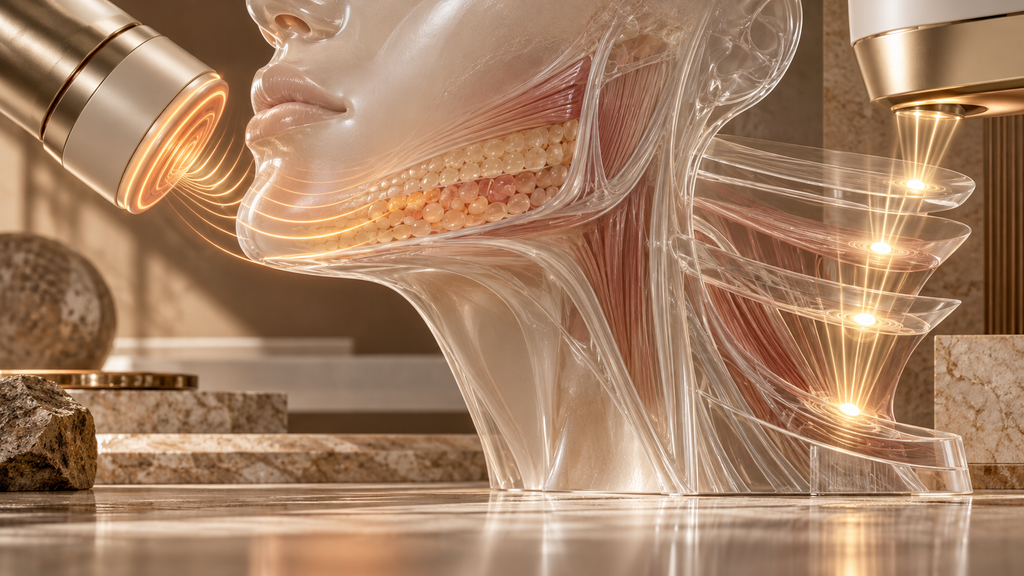
What’s the difference between InMode and ultrasound? First, let’s figure out whether a blurred jawline is caused by fat or sagging.
If you’re also looking to reduce a Double Chin, excess flesh around the mouth, or soften jaw lines, some people are advised to try InMode FX, while others are better suited for HIFU. It’s not a matter of which option is more expensive or “superior” — rather, they work through different mechanisms: InMode FX is often used to address localized contours and areas with concentrated fat, whereas HIFU utilizes focused ultrasound at specific depths to strengthen and lift loose tissues.
Here’s the answer first: For areas with concentrated fat, start with InMode; for sagging skin, opt for ultrasound therapy.
If you can pinch out a noticeable thickness under the chin despite a stable weight, and the Double Chin persists, you might want to consider local contouring treatments like InMode FX first. If there isn’t much fat but the lower jaw line appears loose when looking down, from the side, or while making facial expressions, HIFU could be more effective in addressing the issue.
But this isn’t a formula for remote diagnosis. For those with a thin face, sunken cheeks, a broader skull structure, well-developed Masseter muscles, or extremely thin skin—even if they also feel their jawline is unclear—the treatment approach may still differ significantly. Before choosing a treatment plan, it’s more important to identify what’s “excess” and which layer is “loose” rather than deciding on the equipment first.
What’s the key difference between InMode FX and HIFU?
| Comparison Items | InMode FX | HIFU |
|---|---|---|
| Primary Energy and Operations | It uses RF along with negative pressure contact and moving motions; the actual mode is subject to device and regional approvals. | Focused ultrasound creates an action point at a specific depth; different models, probes, and depths cannot be used interchangeably. |
| Common Questions Asked | There is localized bulk under the chin or along the jawline, and I’d like to refine the contours. | The skin and deeper tissues become loose, causing the jawline to lose its definition. |
| The doctor needs to make a judgment first. | Fat distribution, areas to be preserved, skin thickness, and risk of localized indentation. | Layers of sagging, underlying structure, fat volume, probe depth, and areas where excessive treatment should be avoided. |
| Not suitable for direct application | If your cheeks are naturally thin with noticeable hollows, or if the contour issue stems mainly from bone structure and muscles. | The main issue is localized fat accumulation, or having a too-slim face shape while trying to achieve a tighter look by relying on excessive hair volume. |
| Things We Can’t Guarantee | There’s no guarantee that it will turn into a V-shaped face in just one treatment, nor can all round faces be attributed to excess fat. | It cannot guarantee a noticeable lift in just one session, nor can it replace surgery for all degrees of sagging. |
Look at your lower jaw line in the mirror to observe these 5 possible scenarios first.
| What you’re seeing | This may need to be clarified. | Priority discussion topics |
|---|---|---|
| There’s a noticeable thickness just below the chin that can be felt. | Are localized fat and skin laxity present simultaneously? | We can start by discussing InMode FX-type fractional contouring treatments, and then decide whether lifting is needed. |
| Loose, jagged lines appear along the lower jawline | The degree of sagging between the surface skin and deeper tissues. | Ultrasound or other tightening methods might be more suitable for the goal. |
| The cheeks are thin, and the temples and mid-face also appear sunken. | Insufficient volume, skeletal shadows, and tissue sagging. | Preserve the fat first—don’t equate a “smaller face” with simply reducing overall volume. |
| Square profile with protruding jawlines when biting down | The size of the Masseter and bone structure width. | InMode and ultrasound may not necessarily be the best solutions—muscles and bone structure need to be assessed separately. |
| There’s a big difference between morning and evening, and it’s especially puffy when you wake up. | Swelling, lifestyle habits, medications, or health factors. | First, determine the cause of the change—don’t assume that short-term swelling is actually fat or sagging. |
Why can’t you choose a treatment based solely on a photo for the same face?
Photos can show the contours, but they don’t reveal things like tissue thickness, elasticity, texture, or dynamic changes. From the front, both faces may appear round—some people might have fat accumulation under the chin, while others have a wider jawbone or more prominent Masseter muscles. On the side, excess flesh around the mouth could stem either from volume buildup or sagging deeper tissues.
During the in-person consultation, the doctor not only examines static photos but also observes the contours of the face when looking down, looking up, smiling, and clenching the teeth. They also palpate the thickness of the fat to determine whether the skin is already thin or has indentations. This information directly influences the treatment area, not just the number of grafts needed.
Three specific scenarios, with different treatment approaches
Scenario 1: 30 years old, with a stable weight, but has had a Double Chin on the sides for years.
If a physical examination reveals localized fat beneath the chin with decent skin elasticity, you can consider an InMode FX treatment for targeted contouring. The key is to keep the treatment area focused—don’t try to address the already thin cheeks just because you want a smaller face.
Scenario 2: 42 years old, little body fat, with gradually loosening jawline.
These types of issues are more related to tissue support and sagging. HIFU may be a better solution than simply addressing localized volume loss. Nevertheless, it’s important to first determine whether the cheeks are already sunken, as well as the skin thickness and the appropriate treatment depth.
Scenario 3: 35 years old, with a thin face and sunken cheeks, but shadows appear around the mouth when taking photos.
It’s not recommended to combine InMode treatment with high-intensity ultrasound just because shadows are visible. First, determine whether it’s tissue sagging, ligament displacement, skeletal shadows, or insufficient volume—otherwise, it might only make the existing fatigue more noticeable.
Can InMode and ultrasound treatments be done on the same day?
It can be discussed, but it’s not necessary for everyone. If the two treatments target different layers and areas clearly, with stable skin conditions, the doctor might schedule them on the same day. However, if the irritation is concentrated in the same area, it’s the first time undergoing energy therapy, the face is relatively thin, or there’s a flight to catch the next day, scheduling them separately usually makes it easier to observe reactions.
The prerequisite for doing multiple procedures on the same day isn’t just having enough time—it’s ensuring that each procedure serves a clear purpose. If the doctor can’t explain which treatments target fat, which address sagging, and which areas should be left untouched, then all of them shouldn’t be included just because it makes sense as part of a package. For the detailed sequence, please refer toThe principles behind combining multiple treatment sessions in a single day for medical aesthetics in South Korea。
It’s not the case that the more pulses sent and the higher the energy, the more worthwhile it is.
The number of ultrasound pulses is part of the treatment setup, but it needs to be adjusted based on factors such as probe depth, treatment area, arrangement density, and facial shape. Similarly, InMode’s energy level and treatment time also must be tailored to the tissue thickness, treatment area, and real-time responses. Comparing only the number of pulses or energy levels alone isn’t enough to determine whether a particular treatment plan is suitable.
What really needs to be compared is whether the treatment targets the underlying issue, avoids depressed areas, who performs it, how skin and pain responses are monitored, and whether issues can be tracked if they arise. The name of the machine might be the same, but the assessment could still differ.
How Does NEWYOUNG Clinic Determine Whether to Use InMode or Ultrasound?
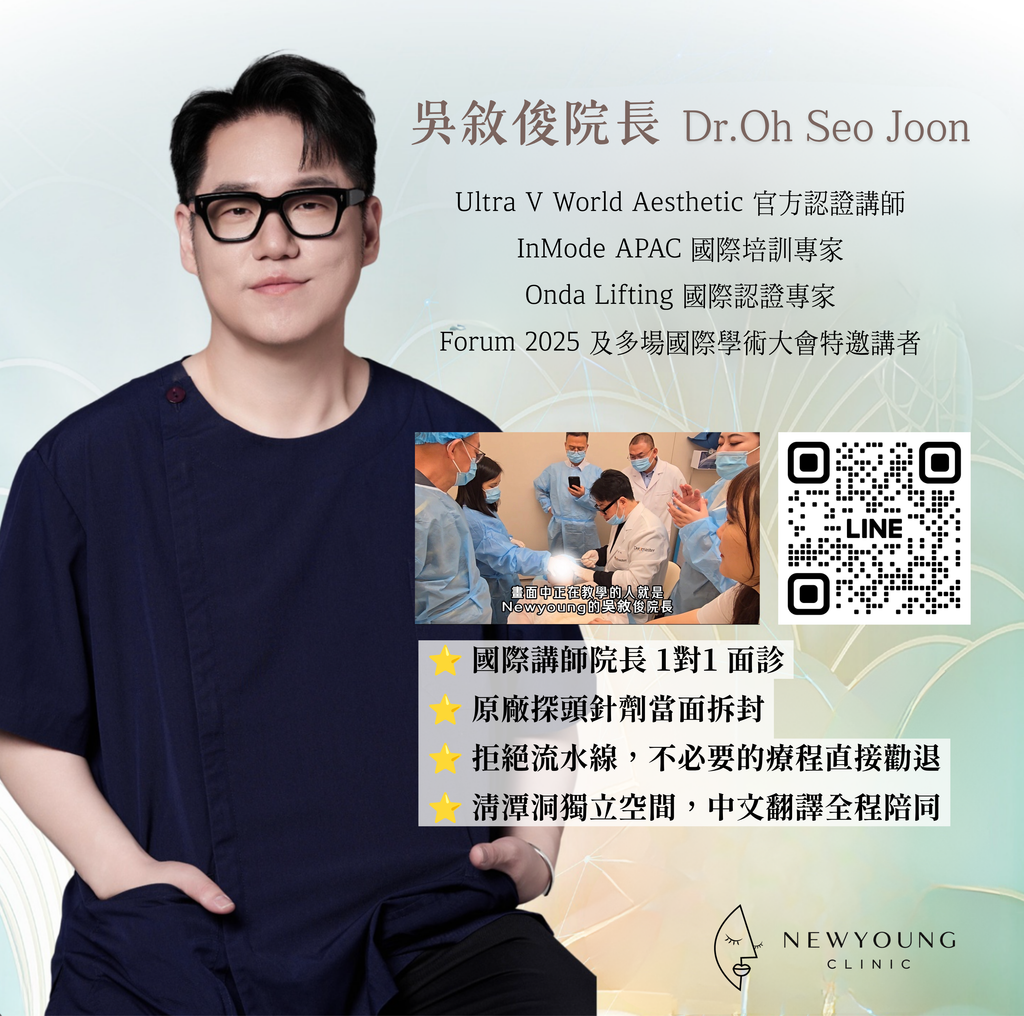
NEWYOUNG Clinic is located in Cheongdam, Seoul. During the one-on-one consultation, Director Oh Su-jun breaks down lower jaw line issues into factors such as localized fat, skin laxity, deep tissues, muscles, and bone structure, before deciding whether InMode FX or HIFU is necessary, or if these treatments should not be prioritized at this time.
For those with a slender face shape or already sunken cheeks, the evaluation also focuses on determining which areas should be preserved, rather than aiming to reduce all soft tissues. Previous articleWhy do different results occur with the same InMode device?It further clarified the differences in treatment areas, preservation sites, and operational controls.
When consulting, ask these 6 questions directly.
- Is my lower jaw line mainly caused by fat, sagging, Masseter issues, or skeletal problems?
- If undergoing InMode treatment, which areas will be treated and which will remain unchanged?
- If ultrasound treatment is used, which model should be chosen, what’s the probe depth, and what’s the approximate treatment area?
- Why is it necessary to do them on the same day instead of doing one first and then waiting to see?
- I already have sunken cheeks or a thin face — how can I reduce the risk of my features looking even drier?
- If obvious pain, numbness, or asymmetry occurs after returning home, which channel should I use to follow up?
What situations require you to contact the clinic as soon as possible after the treatment?
Short-term redness, swelling, tenderness, bruising, or localized numbness may occur. The extent of these symptoms varies depending on the device used, treatment area, energy level, and individual response. Please follow the clinic’s instructions for cleaning, moisturizing, and sun protection. Avoid applying heat packs or massages on your own, nor start any other form of therapeutic treatment right away.
If it occursPain that continues to worsen, large blisters or burns, abnormal skin color, rapidly worsening swelling, obvious asymmetry, continuously increasing sensory abnormalities, or changes in facial expressions and mouth movementYou should contact the clinic that performed the procedure immediately and seek local medical assistance based on your symptoms.
Frequently Asked Questions
Is InMode definitely more suitable for dealing with a Double Chin?
Not necessarily. A Double Chin can result from a combination of fat, loose skin, retracted chin, and issues with deeper tissues. If it’s primarily due to skeletal proportions or significant sagging, a single treatment targeting just one area may not be sufficient.
Can HIFU eliminate fat?
Different HIFU devices, probes, and regions have varying approved indications, so it’s not accurate to refer to HIFU as a general fat-reduction treatment. The effects of HIFU on tissues at specific depths and its lifting capabilities should be discussed based on the device’s design and approved uses.
For people with thin faces, which is safer—InMode or ultrasound?
You can’t choose a device just based on wanting a slimmer face. In both cases, it’s important to avoid over-treating certain areas. For those who already have sunken cheeks, low fat volume, or prominent bone structure, it’s essential to first determine whether the issue truly stems from fat or sagging before deciding on the treatment area.
Which is more painful, InMode or ultrasound?
Pain perception is influenced by factors such as the treatment area, equipment used, energy level, probe or applicator type, anesthesia method, and individual tolerance, making it impossible to provide a fixed score. During your consultation, ask about the specific equipment and pain management techniques employed by the clinic.
Would doing them together yield better results?
Not necessarily. A combination is only worth considering when fat accumulation and sagging truly occur together, and when the two treatments have distinct and clear goals of their own. Simply adding the treatments together doesn’t mean the results will increase proportionally—risks and post-operative reactions also add up.
How long does it take to see results?
The short-term responses and progression rates of these two types of treatments differ, and they are also influenced by the treatment method and individual factors. Don’t judge the final outcome before the swelling has subsided, nor should you use the time taken in a single case as a guarantee for your own situation.
Can I send photos so the clinic can choose a treatment plan first?
Photos can help discuss the overall contours and main concerns initially, but they cannot replace physical examination, dynamic observation, and assessment of tissue thickness. While you can consider a Reduction surgery option online first, the actual procedure and scope should still be determined in person.
Contact NEWYOUNG Clinic
Clinic Name:NEWYOUNG Clinic / NEWYOUNG Dermatology / 뉴영의원
Address:78-9, Cheongdam-dong, Gangnam-gu, Seoul Special City
Transportation:Exit 3 at Apgujeong Rodeo Station, approximately 118 meters on foot
Official website:https://www.new-young.com/
LINE:@096fpaaj
WhatsApp:+82 10-8189-6892
WeChat:time1733_
Instagram:@newyoung.clinic