
The price of anti-aging cosmetic treatments in South Korea doesn’t necessarily reflect the quality of the procedure. What truly matters is whether the treatment addresses your specific concerns, who will assess and perform it, what quality standards are used, what’s included in the quote, and whether you can get support if issues arise after returning to Taiwan. For Taiwanese travelers, the best option is usually one that comes with clear explanations, transparent information about risks, a complete breakdown of costs, as well as an acceptable recovery period and budget.
When you see huge price differences for the same treatment at different Seoul cosmetic clinics, don’t rush to choose the lowest option, and don’t assume that a higher price necessarily means better results. Below is a decision-making framework you can use before making an appointment, attending a consultation, and making a payment.
Let’s start with the conclusion: What are the 7 key factors to consider when comparing prices for anti-aging cosmetic procedures in South Korea?
- Are your main concerns and treatment goals clear?
- Are the full name of the treatment, model, probe, or consumables identical?
- Are the number of sessions, dosage, treatment area, scope of procedure, and frequency of application all consistent?
- Was there a face-to-face consultation with the actual performing doctor who explained the reasons for the choice?
- Does the quote include VAT, anesthesia, supplies, medications, and post-operative items?
- Are common side effects, significant risks, recovery time, and alternative options clearly explained?
- Are the contact details and emergency signals for seeking medical help clear after returning to Taiwan?
As long as one of these aspects is ILCHI, the two prices may not correspond to the same service, so you can’t simply judge based on which number is higher or lower.
Why can the prices for the same treatment vary so much in South Korea?
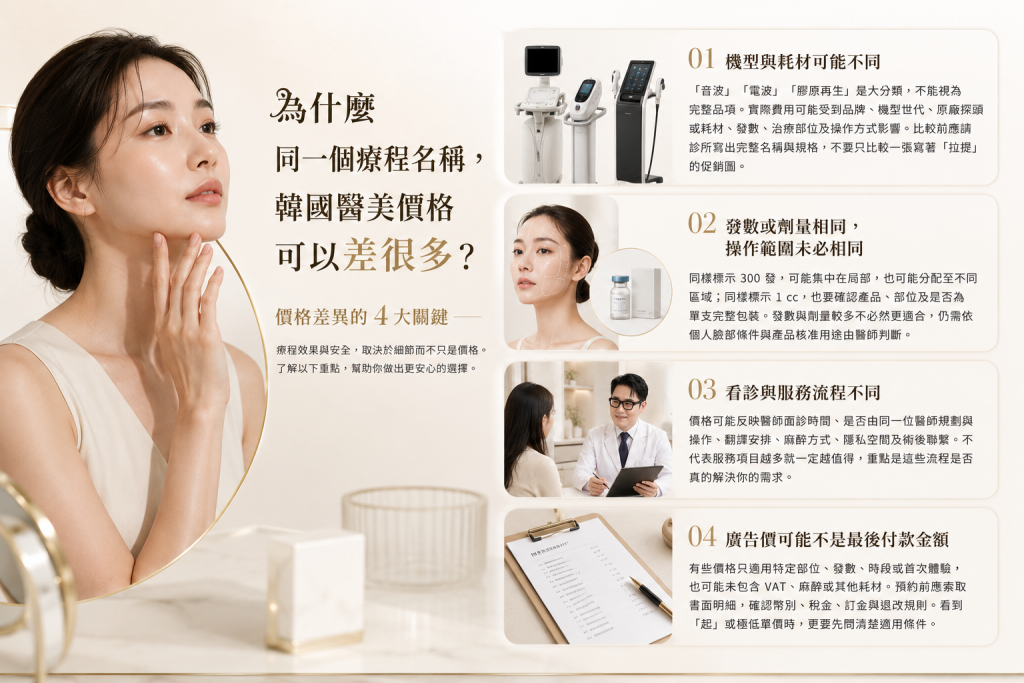
The models and consumables may vary.
“Ultrasound,” “Radiofrequency,” and “Collagen regeneration” are broad categories and should not be considered complete treatment options. The actual cost can vary depending on the brand, model generation, original probes or consumables used, treatment frequency, area being treated, and the procedure method. Before making a comparison, ask the clinic to provide detailed information about the specific names and specifications of each treatment, rather than relying solely on promotional images that simply say “lifting.”
Even with the same number of treatments or dosage, the treatment area may not be identical.
Products labeled as 300 centum cores may be applied in concentrated areas or distributed across different regions; similarly, for those labeled as 1 cc, it’s important to verify the product type, application area, and whether it comes as a complete single package. A higher number of units or dosage does not necessarily mean it’s better — the decision still needs to be made by a doctor based on individual facial characteristics and the approved uses of the product.
The consultation and service processes are different.
The price may take into account factors such as the time spent for a face-to-face consultation with the doctor, whether the procedure is planned and performed by the same doctor, translation services, anesthesia method, privacy provisions, and post-operative follow-up. It doesn’t mean that more service items necessarily make it more worthwhile; what matters most is whether these processes truly address your needs.
The advertised price may not be the final amount due.
Some prices are only valid for specific areas, number of sessions, time periods, or first-time bookings, and may not include VAT, anesthesia, or other supplies. Be sure to request a written breakdown before making a reservation to clarify the currency, taxes, deposit requirements, and cancellation policies. When you see an “starting” price or an extremely low rate, always ask about the applicable terms first.
7-Step Assessment: Is This Seoul Anti-Aging Treatment Right for You?
Step 1: Start by talking about the concerns, and put the treatment name aside for now.
Replace “I want to get a certain device” with a more specific description, such as:
- Even at rest, I feel my mid-face has sunk.
- The jawline isn’t clear in photos, but I don’t want my face to look even more sunken.
- Worried about deepening Nasolabial Fold Correction while also seeking natural-looking expressions.
- It looks tired at first glance, but it’s hard to tell whether it’s due to sagging, pigmentation, or skin issues.
The same cosmetic concern can involve different levels of severity. Photos can be used for communication before scheduling a consultation, but they cannot replace an in-person examination and face-to-face consultation with a doctor.
Step 2: Ask the doctor to explain “why this specific procedure?”
A straightforward recommendation should at least answer: where the main issues are likely to stem from, which level needs to be addressed this time, why this treatment was chosen, what other alternatives exist, and which issues will not be dealt with this time.
If the answers are simply “the most popular right now,” “everyone is getting it done,” or “the more treatments, the better,” it’s advisable to hold off on making a payment. Treatment choices should be based on your individual condition, medical history, and goals.
Step 3: Break down the products into comparable specifications
For energy-based treatments, make sure to confirm the exact device model, treatment area, number of sessions, probes/consumables used, and whether an in-person verification is possible. For injection-based treatments, verify the product name, volume per vial, estimated number of vials needed, injection site, method of opening, and batch number records. In the case of combined treatment plans, ask the clinic to list each item separately to avoid receiving just a general description of the package.
Step 4: First calculate the total cost, then compare it with your budget.
You can ask the clinic to provide the following details in Korean won:
| Cost breakdown | Things to Check Before Making a Payment |
|---|---|
| The treatment itself | What are the full name, treatment area, and number of hairs/dose/number of sessions? |
| VAT | Is the price inclusive of tax? How is the tax amount calculated? |
| In-person consultation and examination | Is there an additional fee? Under what circumstances is an extra examination needed? |
| Anesthesia & Supplies | Does it include numbing agents, sedation, probes, or disposable items? |
| Medications and post-procedure supplies | Is it charged separately? Which items are mandatory? |
| Deposit and Cancellation Policy | What should I do if I need to reschedule, cancel, or if the doctor determines it’s not suitable? |
If there are exchange rate fees and overseas card transaction charges, they should also be included in the total travel budget. The key to transparent pricing is being able to know the full cost and requirements in advance of starting the treatment.
Step 5: Include the recovery period in the costs
The cost of getting medical beauty treatments in South Korea also includes downtime, adjustments to the itinerary, and follow-up care after returning to Taiwan. Even if a certain treatment is often described online as “lunchtime-friendly,” individual reactions such as redness, swelling, bruising, pain, or other side effects can still vary. Avoid scheduling important events too close to your treatment, and never combine multiple treatments on your own without a doctor’s evaluation.
Step 6: Identify risks, contraindications, and alternatives
Aesthetic medicine remains a medical procedure, and uncertainties are inherent in it. Before making payment, you should proactively disclose any illnesses, allergies, medications being taken, pregnancy or plans to conceive, implants, as well as past aesthetic treatment history. Ask your doctor to explain common side effects, less common but significant risks, warning signs that require immediate medical attention, and alternative options of skipping or delaying the procedure.
If you don’t fully understand or the translation is incomplete, you can pause your decision for now. The purpose of informed consent is to make a choice after understanding; signing alone cannot replace the explanation.
Step 7: Confirm who you can reach upon returning to Taiwan
For cross-border treatments, you should obtain from the clinic the official name of the clinic, the date of the procedure, records of the treatment and products used, post-procedure care instructions, and official contact information before leaving. Also, make sure to ask how common side effects should be handled, when a follow-up appointment is needed, who to contact first in case of any issues after returning to Taiwan, and what medical records the clinic can provide.
Medical Korea, operated by South Korea’s Ministry of Health and Welfare and the Korea Health Industry Development Institute, offers a registration system and search portal for medical institutions that attract foreign patients. Clinics or intermediaries serving foreign tourists can check whether a facility is registered before making an appointment; however, being “registered” does not guarantee specific results for any individual or treatment plan.
What pitfalls should you avoid with cheap and expensive options?
When you see a low price, first check if any requirements are missing.
- Is it limited to very small areas or a smaller number of treatments?
- Is it excluding VAT, anesthesia, supplies, or post-operative items?
- Are there any restrictions on specific time periods, quantities, or required purchases?
- Whether the doctor performing the actual procedure is the same as the doctor who conducted the consultation.
- Is it easy to add extra items on the spot without proper explanation?
Low prices may stem from a sound business model or promotional strategies, and it doesn’t necessarily mean the quality is inferior. It’s only when the terms and conditions aren’t clear that it’s a sign to pause comparisons.
When you see the high price, check whether the extra cost is worth it for you.
- Is there sufficient time for thorough doctor evaluations and consultations?
- Are different models, consumables, treatment frequencies, or dosages used?
- Does it include translation, a private space, and follow-up contact?
- Is there a clear decision-making process for selecting treatments, rather than simply adding more procedures?
- Brand location and space costs – do they align with the experience you value?
Even high prices don’t guarantee results or eliminate risks. If you can’t see the difference, ask for a detailed breakdown before deciding whether it’s worth it.
3 common scenarios for making a choice: What are you really comparing?
Scenario 1: Visiting Korea for the first time with a fixed budget
First, let your doctor know your budget and ask them to categorize the procedures into three groups: “to be done first,” “can be postponed,” and “not needed for now.” Even if fewer procedures are done at once, it’s still a better choice than adding uncertain treatments just to qualify for a package discount.
Scenario 2: Multiple fillers or lifting procedures have already been done
Organize the date, treatment area, product used, number of sessions, or dosage; be honest if the information is incomplete. At this stage, the value of an in-person consultation and medical history usually outweighs simply adding popular procedures quickly. Whether imaging or other tests are needed should be determined by the doctor based on the individual’s condition.
Scenario 3: Short trip duration with important commitments back in Taiwan
List the return date and the event date on the consultation form, and ask the doctor to rearrange them based on acceptable recovery patterns. If you can’t handle the uncertainty of swelling or bruising, consider delaying the procedure rather than insisting on completing it no matter what.
Comparing anti-aging clinics in Cheongdam: NEWYOUNG Clinic’s approach
NEWYOUNG Clinic is located in Cheongdam, Seoul, right near the Apgujeong Rodeo area. The clinic focuses on one-on-one consultations with its doctors, natural anti-aging treatments, and personalized treatment plans created by medical professionals. For visitors who are unsure about the costs, they can first share their budget, top concerns, any limits they have regarding changes, and their return date to Taiwan. The doctor will then determine the priority of treatments based on the patient’s facial structure, skin condition, and previous treatment history.
According to the current information provided by NEWYOUNG Clinic, prices are listed in South Korean won and do not include VAT. Both local South Korea patients and foreign clients are subject to the same pricing policy, with Chinese translation services available. The injection procedures emphasize open packaging right in front of the patient, and the clinic is known for its quiet, private, and upscale treatment environment. All details such as the process, services available on the day, final quote, risks, and recovery period should be confirmed again during the appointment and consultation.
The natural look that NEWYOUNG emphasizes is a guiding principle, not a guarantee of results. A sound anti-aging plan should allow doctors to explain what can be reduced in this treatment, giving you the option to choose not to proceed after fully understanding the details.
Recommended reads: “What Kind of Clinic Is NEWYOUNG Clinic? Who Is It Suitable For?” and “Why Do So Many People Choose Cheongdam for Anti-Aging Treatments? What Are the Differences Between Cheongdam and Myeongdong Medical Spa Services?”
Price inquiry checklist ready to copy before in-person consultation
You can pass on the following details to the Seoul cosmetic clinic:
What matters most to me is __. I hope to keep __ intact. An acceptable recovery period is __ days, with a total budget of around __ South Korean won. Please suggest the full name of the treatment plan, including the device/product used, the treatment area, as well as the number of hairs/doses/sessions. Also please list separately the costs for VAT, anesthesia, consumables, medications, and post-operative supplies. I’d like to know who will conduct the consultation and perform the procedure, what are the common side effects, the key risks involved, any alternative options, and the official contact information after returning to Taiwan. Whether I proceed with the treatment or not will be decided after meeting with the doctor and understanding all the details.
Conclusion: The price is reasonable, but it’s unclear whether the information provided is accurate.
When evaluating the prices of anti-aging cosmetic treatments in South Korea, there’s no need to first identify the cheapest or most expensive clinic in all of Seoul. It’s important to first clarify the specific issues being addressed, the procedures involved, the practitioner performing the treatment, the total cost, potential medical risks, and follow-up care options—only then can you have a proper basis for comparison.
Only if a treatment plan can clearly answer questions such as “why it’s suitable for me, exactly what will be done, what might happen, how much it will cost in total, and what to do after returning to Taiwan” should it be considered a viable option. The final decision should still be made by a qualified physician after a face-to-face assessment of individual conditions.
If you’re planning to undergo medical beauty treatments in South Korea from Taiwan and would like to assess your facial concerns in Cheongdam, Seoul, before determining your budget, you can schedule a consultation with the clinic’s director at NEWYOUNG Clinic. It’s recommended to provide your travel dates, photos taken in natural light, previous treatment history, and your budget range in advance. The actual suitability, treatment details, risks, recovery time, and final cost will be determined based on the assessment by the doctor on-site and the written information provided by the clinic.
Information verification sources
Review date: August 5, 2026.
- South Korea’s Ministry of Health and Welfare / Medical Korea of the Korea Health Industry Development Institute: Registration System for Medical Institutions Serving Foreign Patientshttps://www.medicalkorea.or.kr/en/registeredsystem
- Medical Korea – Search for foreign patient recruitment agencies:https://www.medicalkorea.or.kr/en/registeredhospitals
- Ministry of Health and Welfare, Taiwan, “Ministry Reaffirms that ‘Aesthetic Medicine’ Falls Under the Category of ‘Medical Procedures’”:https://www.mohw.gov.tw/cp-2704-21697-1.html
- Taiwan Ministry of Health and Welfare, Food and Drug Administration – Medical Device Information and Licensing Database Portal:https://www.fda.gov.tw/Tc/site.aspx?r=1172345313&sid=39
Editor’s Note: The TFDA database in Taiwan can help travelers understand the concept of verifying medical device information; however, for devices and products actually used during treatments in South Korea, it is still necessary to confirm them based on information approved by South Korea’s regulatory authorities and details provided at the clinic. This article does not imply that Taiwan’s approval status can replace compliance checks under South Korean regulations.